A Sabbath Slaughter
Analyzing Scotland’s Most Coordinated Clan Ambush

The year is 1554, and the Scottish Lowlands, particularly the region around Blairgowrie, are a volatile tapestry of shifting loyalties and ancient grudges. While grand narratives of queens and reformers dominate the history books, the true pulse of the era often beat in the localized, brutal feuds between powerful families. One such event, the assassination of George Drummond and his son William, stands out not just for its barbarity, but for the chilling sophistication of its execution. It was an act of premeditated violence, orchestrated with a level of planning that speaks volumes about the ruthless nature of 16th-century Scottish clan warfare. Central to this dark drama were “the spyis,” the eyes and ears that ensured the deadly plan unfolded with precision.
The Sunday Setting: A Facade of Peace
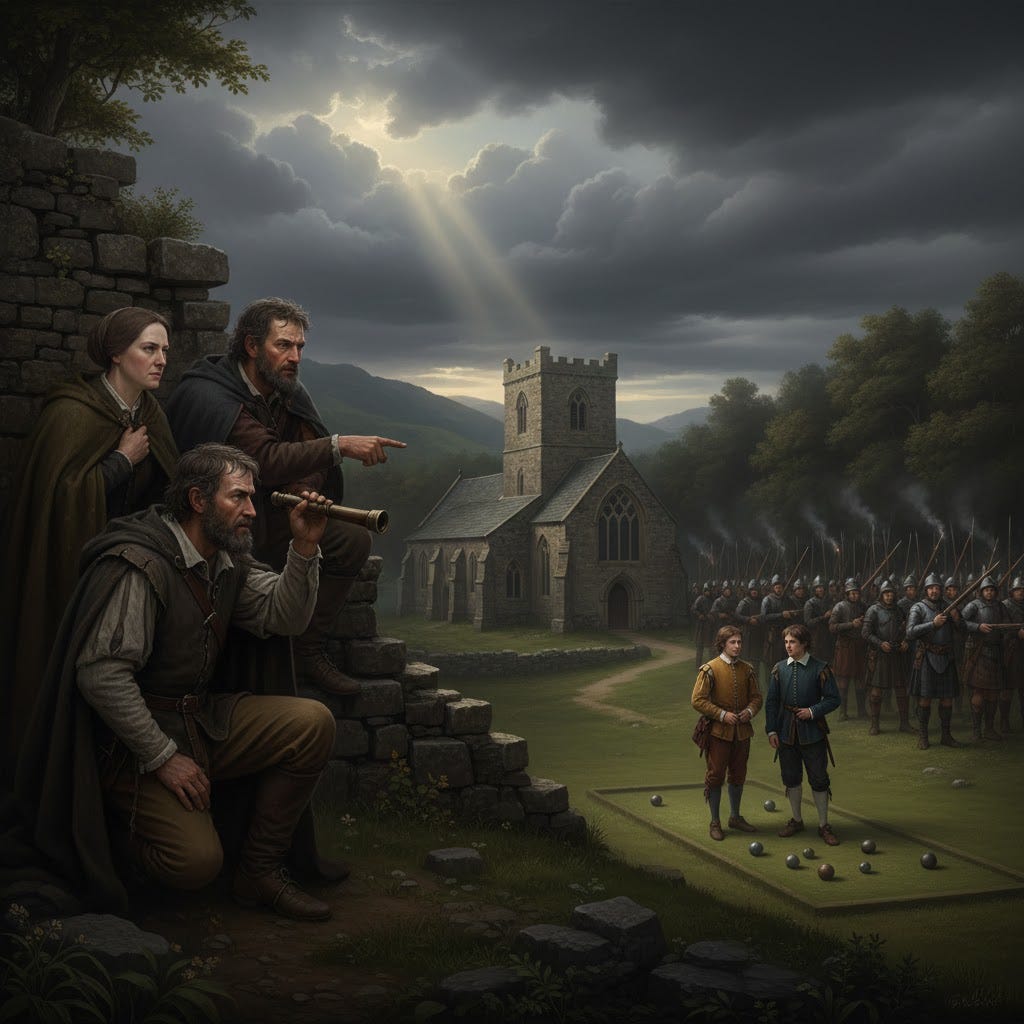
The ambush on George and William Drummond occurred on a seemingly ordinary Sunday afternoon in June. The location itself—”ye hie mercate gait, behynde ye Kirke of Blair”—suggests a place that should have been sanctified by peace and community. Sundays were traditionally a day of rest and worship, a time when hostilities were often, though not always, suspended. The Drummonds, engaged in a game of “rowbowlis” (lawn bowls), were described as being in “sober manner, trusting na truble nor harm to haif bein done to them, but to haif levit under Goddis peace and ouris.” This poignant detail underscores their expectation of safety, a trust that was about to be catastrophically betrayed.
The choice of a Sunday, and specifically a public space behind the church, was likely strategic. It lulled the victims into a false sense of security, making them less vigilant. Furthermore, the presence of others, even if not directly involved, might have served as a macabre audience, sending a clear message about the power and ruthlessness of the attacking faction. This wasn’t just murder; it was a public declaration of dominance.
The Network of Surveillance: Gormack’s Spies
The legal summons, a document of remarkable detail, explicitly mentions the role of intelligence gathering in the plot. The initial plan, even more audacious, was to strike the Drummonds at their “Perroche Kirke of Blair” during the church service. When this failed—”becaus they could nocht cum to thair perversit purpois”—the conspirators did not abandon their objective. Instead, they regrouped at “the Laird of Gormokis place of Gormok and thair dynit with him.” This detail reveals a chilling pause, a moment of strategic recalibration rather than frustrated retreat.
It was during this regrouping that “spyis” were deployed. These individuals were tasked with monitoring the Drummonds’ movements after the service. Their report—that George and William were “cuming furth of his place” and engaged in their game of bowls—was the crucial piece of information that triggered the final, lethal phase of the ambush.
Who were these “spyis”? While the document doesn’t explicitly name them as dedicated intelligence operatives, they were likely household members, tenants, or retainers loyal to John Buttir of Gormack or one of the other implicated lairds. In a close-knit community, such individuals could easily observe and report without arousing suspicion. Their role highlights an underappreciated aspect of historical feuds: they were not always spontaneous brawls, but often meticulously planned military operations, scaled down to a local level. The use of spies demonstrates a strategic foresight, an understanding of target vulnerability, and a calculated approach to overwhelming an opponent.
The Coordinated Strike: A Show of Force
With the intelligence gathered, the ambush was launched. The sheer scale of the attacking force is staggering: “with thair complices with ye said Laird of Gormokis householdmen and servantis bodin in feir of weir...to ye nomer ot 66 personis,” in addition to the initial 30. This makes a total of nearly 100 armed men, equipped with “jakkis, coittis of mailye, steil bonnetis, lance staffis, bowis, lang culverings with lichtit luntis, and utheris wappinis invasive.” This was not a handful of angry men; it was a small army.
The coordination suggests clear leadership and a well-understood chain of command. The attackers “ischit further of ye said Laird of Gormokis place foirsaid and imbeset ye gait to ye saidis umqle George and William his sone.” “Imbeset ye gait” means they blockaded or surrounded the path, cutting off any possibility of escape. This tactical maneuver, combined with their superior numbers and weaponry, ensured the Drummonds had no chance. The mention of “lichtit luntis” (lit matches for the culverings) implies a readiness to use firearms, a terrifying prospect for individuals armed only for a game of bowls.
The motivation behind such a grand display of force was likely manifold. Beyond simply eliminating the Drummonds, the conspirators aimed to:
Assert Dominance: By publicly and violently eliminating their rivals, they sent a clear message to anyone else who might challenge their authority or encroach upon their interests.
Deter Future Opposition: The spectacle of the ambush served as a brutal deterrent, showcasing the consequences of crossing the combined might of these families.
Demonstrate Unity: The involvement of multiple lairds and their retinues underscored a powerful alliance, making the statement even more potent.
The Legacy of the Spies and the Ambush
The events of June 3, 1554, provide a grim illustration of the localized anarchy that could prevail in Scotland. The “spyis of Gormack” and the coordinated ambush they enabled reveal a strategic mindset behind what might, at first glance, appear to be a chaotic act of violence. It underscores that even in the absence of a strong central authority, local power structures could operate with terrifying efficiency and ruthlessness.
The detailed legal records, from the initial summons to the subsequent attempts at recompense and the eventual executions, serve as invaluable historical documents. They peel back the layers of a society where life could be cheap, justice was often negotiable, and a Sunday game of bowls could, with the aid of a few well-placed “spyis,” become the stage for a premeditated, brutal assassination. The Kirk of Blair, standing silently through centuries, holds the echoes of that fateful day when peace was shattered, and the shadows of Gormack’s spies fell upon two unsuspecting men.
Adapted From: MacDonald, J. A. R. (1899). The history of Blairgowrie (town, parish, and district). Advertiser Office.