Inverkip’s Shadow
A Pre-Witch Craze Legend

Long before the fires of Paisley, and decades before the infamous Bargarran witch trials, the quiet Scottish parish of Inverkip had already earned a dark reputation. While most witchcraft prosecutions in Scotland peaked between 1640 and 1690, Inverkip stood out as a curious anomaly—its notoriety predating formal accusations and official trials. According to local records and folk songs, Inverkip was a place where witches were said to dwell freely, untouched by the courts, yet feared by the people.
In a time when superstition mingled with daily life, stories were more than just tales—they were warnings, suspicions cast into rhyme, and oral indictments passed from generation to generation. Inverkip became one of those places whose very name inspired unease, largely thanks to one man: “Auld Dunrod.”

The Legend of Auld Dunrod: A Witch Among the Gentry
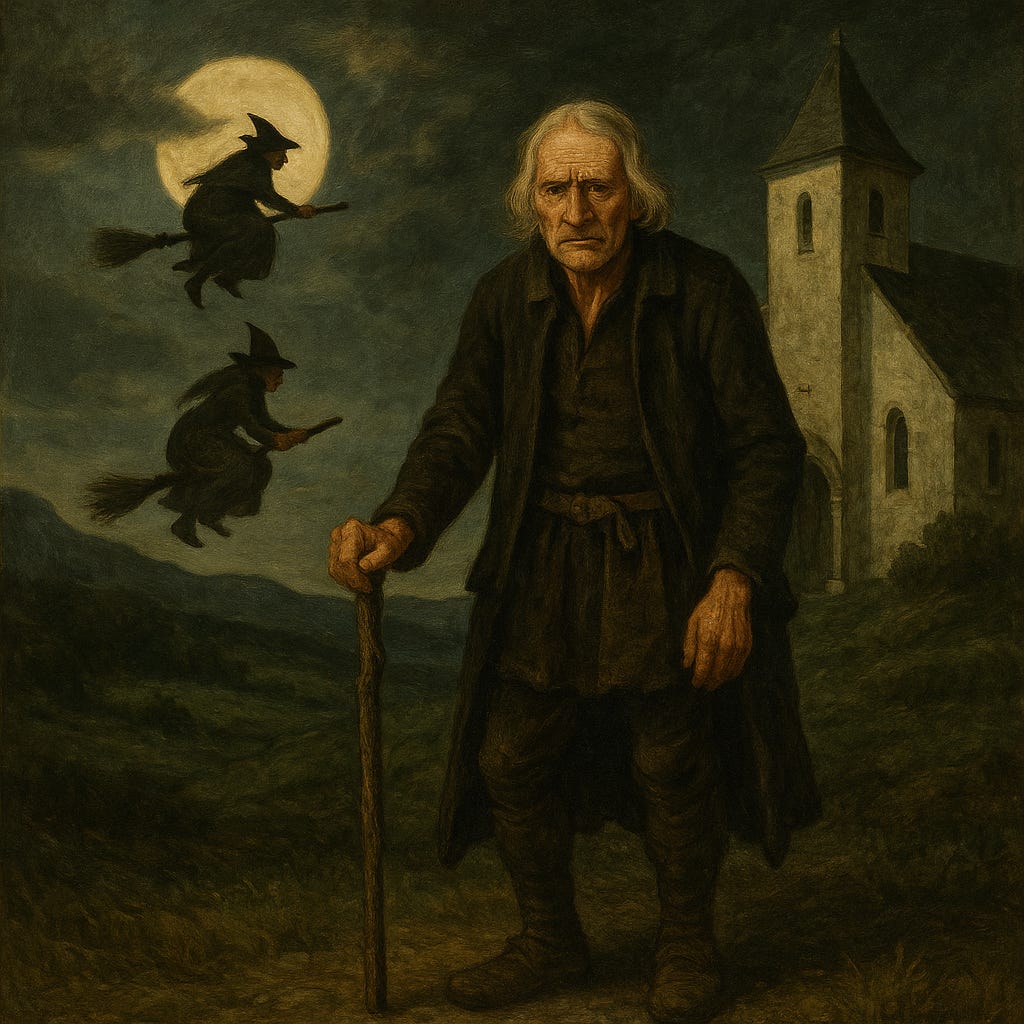
In the early 1600s, a figure known only as Auld Dunrod cast a long and lasting shadow over the parish. His real name is obscured by legend, but we know he once held the barony of Dunrod, which he sold in 1619 to Archibald Stewart of Blackhall. It wasn’t the land deal that etched his name into folklore—it was the claim that Dunrod had dealings with the Devil himself.
He wasn’t some fringe character living on the margins of society. Dunrod was a landowner, and likely educated, making his reputation as a “sorcerer” all the more unusual. According to local ballads, he wasn’t simply accused of witchcraft—he was revered and feared as its master. One memorable stanza goes:
“In Auldkirk the witches ride thick,
And in Dunrod they dwell,
But the greatest loon amang them a’
Is auld Dunrod himsel’.”
Ballads like this weren’t official documents, but they functioned as community records—a kind of poetic folklore-based justice system. They placed Dunrod at the center of a supernatural ecosystem: a nexus for witches, charmers, and agents of Satan, long before any magistrate penned a charge sheet.
A Landscape Haunted by Belief
Why Inverkip? The answer likely lies in its isolation, topography, and religious tension. The region’s woodlands, hills, and coastal fog offered a ready canvas for myth-making. The ancient church and surrounding lands held a history stretching back to medieval times, with Celtic and early Christian sites providing the spiritual foundation upon which new legends grew.
In times of uncertainty, stories of witches served multiple functions:
They explained misfortunes—spoiled crops, dead cattle, sudden illness.
They enforced social conformity—labeling those who lived differently as dangerous.
And they provided cautionary tales about the dangers of straying from the Kirk.
Inverkip, with its sparse population and strong oral tradition, became fertile ground for these superstitions to thrive.
Before the Trials: Fear Without Fire
What makes Inverkip’s story particularly fascinating is that no prosecutions occurred here initially—only rumors, songs, and suggestions. When the records of the Presbytery of Paisley begin referencing witchcraft in the 1660s, Inverkip is already known as “a place of witches,” despite no one being formally tried or burned yet.
The first real church involvement comes in 1664, not with a witch, but with a minister: John Hamilton. He was deposed for allegedly taking a bribe to protect a woman suspected of witchcraft. Even here, the Church’s concern wasn’t the witch herself, but the corruption of one of its own—a clear indication that while superstition loomed large, the judicial machinery of witch-hunting hadn’t yet clicked into gear.
In this way, Inverkip represents an earlier stage in the evolution of Scotland’s witch panic. It was a place of whispered stories, not executions. But those whispers laid the groundwork for what came next.
Legacy of a Haunted Parish
Though Inverkip never matched Paisley in terms of body count or burnings, its role in the witchcraft narrative is arguably just as important. It shows how folklore preceded legal action, and how long-standing reputations could shape the perception of an entire community. Before any gallows were built or trials convened, public opinion had already labeled Inverkip as “bewitched.”
The story of Auld Dunrod lingers today not because of historical fact, but because of cultural memory—the kind passed through rhymes and fireside tales. That cultural memory primed the pump for later paranoia. Once the real witch-hunting began in earnest, legends like those from Inverkip gave fuel to flames that would eventually burn real people.
Inverkip’s shadow, then, wasn’t just a mythic one—it was a precursor, a soft murmur of fear that would later grow into a scream.
Adapted From: Metcalfe, W. M. (1905). A history of the county of Renfrew from the earliest times. Paisley, Scotland: Alexander Gardner.