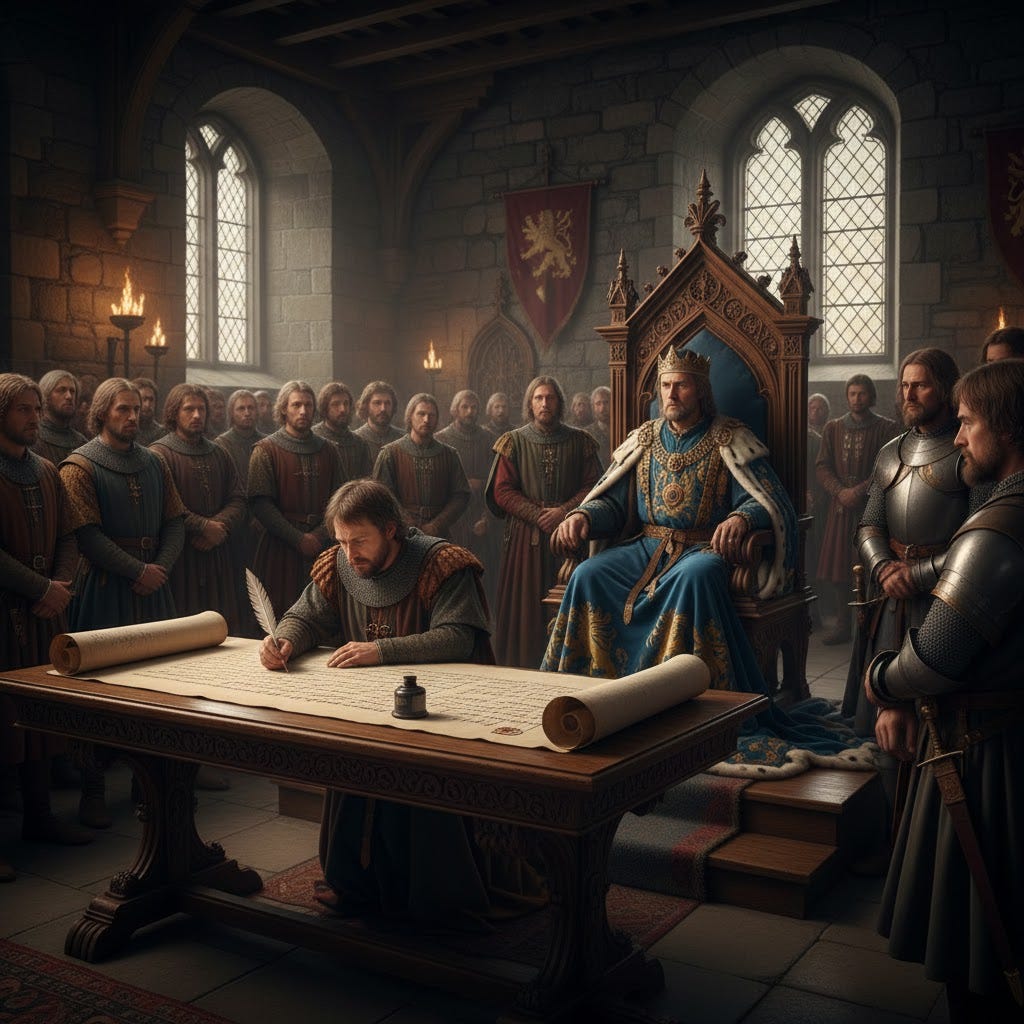
Philip de Fyndon
The man who chose the English side in the age of Wallace

In the landscape of Scottish history, names like William Wallace and Robert the Bruce are synonymous with fierce independence and national martyrdom. However, for every hero on the battlefield, there were dozens of landowners like Philip de Fyndon—men who had to navigate the brutal reality of survival when the “Hammer of the Scots,” Edward I, brought his army north.
The story of Philip de Fyndon is not one of cinematic rebellion, but of the precarious life of a 13th-century nobleman caught between a crumbling Scottish administration and an unstoppable English machine.
The Weight of the Quill: Homage at Berwick
In 1296, the political climate of Scotland shifted from tension to total occupation. King Edward I of England marched into Berwick-upon-Tweed, leaving a trail of destruction that sent a clear message to the Scottish nobility: submit or lose everything.
It was here that Philip de Fyndon appeared to perform “homage.” By signing the Ragman Rolls—a collection of instruments of fealty—Philip effectively traded his national allegiance for the security of his family and the Estate of Findon. To modern eyes, this might look like a betrayal of Wallace’s cause, which was then beginning to stir. However, in 1296, the Scottish throne was vacant, the “Competitors” were bickering, and Edward I was the most formidable legal and military power in Britain. For Philip, choosing the English side was likely a pragmatic attempt to keep the peace he had so carefully negotiated on the Moor of Nigg just fifteen years prior.
Living in the Shadow of Wallace
While Philip de Fyndon was solidifying his status with the English administration, the rest of the country was descending into a guerrilla war. William Wallace’s rising at Lanark and his subsequent victory at Stirling Bridge in 1297 turned “English-aligned” landowners into targets.
Philip occupied a dangerous middle ground. As a man who had done homage to Edward, he was technically an enemy of the Scottish resistance. Yet, as a resident of Kincardineshire, he was deep within territory where Wallace’s men operated. The historical record suggests that Philip “favoured the English party during the struggle,” which would have made the Estate of Findon a place of high tension—a pocket of English loyalty in an increasingly rebellious north.
The Cost of the Wrong Side: Confiscation
The gamble of loyalty is only as good as the victor’s endurance. For Philip, the rise of Robert the Bruce spelled the end of the de Fyndon influence. Bruce did not look kindly upon those who had bolstered English rule during the interregnum.
By 1319, with Bruce firmly established as King of Scots, the consequences of Philip’s 1296 submission were finalized. The estate was confiscated by the Crown. In a move that highlighted the total shift in power, the rents from Philip’s former lands were granted to John Crab, the Flemish engineer who had helped Bruce reclaim Berwick from the English. Philip’s legacy of careful land management and legal boundary-setting was essentially erased by the tides of the Wars of Independence. He was a man who chose the “stable” side, only to find that in a revolution, stability is the first thing to burn.
A Legacy Lost to Legend
Philip de Fyndon is a reminder that history is rarely a simple tale of “good versus evil.” He was a man of his time—a proprietor who valued the “marches” of his land and the legality of the Justiciary Court.
While he is often overshadowed by the larger-than-life figures of Wallace and Bruce, his story provides a vital window into the lives of the Scottish gentry who were forced to make impossible choices. He chose the English side to save his estate, and in a poetic turn of history, he lost that very estate to the man who built the engines of Scottish victory. Today, we remember the name Findon for its fish, but the man behind the name was a central figure in one of Scotland’s most turbulent political eras.
Adapted from: Henderson, J. A. (1890). History of the parish of Banchory-Devenick (W. Taylor, Illus.). D. Wyllie & Son.