“Tyne His Freedom”
What It Meant to Lose Burgess Rights

In the Scottish court books, little phrases carry big consequences. Few are heavier than “tyne his freedom.” To “tyne” was to lose; “freedom” meant more than a vague idea of liberty. It was a legal status—the precious standing of a burgess—and with it came a bundle of rights, responsibilities, and daily privileges that made burgh life possible. When a person “tyned” (lost) that status, their world could shrink overnight.

What Was a Burgess—And Why It Mattered
A burgess was an enrolled freeman or freewoman of the burgh. Think of it as a membership that unlocked civic life:
Economic muscle. Burgesses could trade in the town legally, keep a booth or stall, fish in local waters, and sell goods at regulated prices. They enjoyed access to shared resources like common grazing (“the comon gress”) and town mills.
Property & protection. They could hold burghal property and benefit from the town’s legal shield in disputes—being tried locally, with local custom in mind.
Political voice. Burgesses served on councils, juries (assizes), and pricing boards; they voted—formally or informally—on officers and policy.
Duties in return. They paid scot and lot (local dues), kept watch and ward, obeyed market rules, maintained street sanitation, and turned out for musters or repairs. The books are full of these duties: sweeping calsays, keeping middens off the high street longer than eight days, and keeping Sabbath trade closed until the approved hour.
Freedom of the burgh, then, was not abstract honor. It was the key to work, property, and belonging.
How You Could Lose It
Arbroath records show a ladder of penalties—apology at the cross, amerciaments (fines), law-borrows (peace bonds), stocks/jougs, banishment for “year and day,” and at the top, loss of freedom. The court often tried to repair harm first; only when behavior threatened public order did it reach for the harshest tool.
Breaking plague rules. During outbreaks (“the pest”), Arbroath enforced strict controls: no unlicensed lodging of strangers, house checks by quarter masters, and bans on travel to risky markets. 23 September (1566) shows how serious this was: John Hynd’s freedom is discharged for slipping off to Brechin market without leave. Others who hosted outsiders against orders were warned they could tyne their freedom and common lands if they repeated the offense.
Incorrigible insults and disorder. Words could be crimes. Courts forced public apologies for slander (“missaying”), but repeat offenders faced escalation. In 1567, the council decreed that if John Ramsay hurled injurious words at Jonat Lam again, he would lose his freedom and common lands—a clear line in the sand.
Defying market regulation. Burgesses who forstalled grain, sold ale too dear, or hid stock could be fined and, on repetition, threatened with banishment or loss of standing. A 1566 statute against hoarding meill (meal) escalated to banishment for year and day if a seller disobeyed the bailies’ order to sell.
Persistent civic contempt. Some entries warn that if a person keeps breaking council acts—on sanitation, Sabbath trading, or public order—next fault doubles and can end in tyning freedom. It’s the seventeenth-century version of “you’re on notice.”
A telling complement to all this is the 1567–8 statute that no “out man” be made free for seven years. In hard times, the burgh protected the value of freedom by restricting access to it—scarcity reinforced status.
What “Tyne His Freedom” Actually Cost You
Losing freedom wasn’t a slap on the wrist; it was civil death within the burgh.
Work & income. You could not lawfully keep a booth, sell at the market, or use town dues like the anchorage, customs, and mill as a burgess. Trading as an “unfreeman” brought the stocks or the gowis/jougs, plus fines.
Land & resources. Much of a burgess’s material security came from access to common grazing and burghal plots. “Tyne his common lands” meant losing pasture and the right to benefit from communal assets—serious for anyone with beasts or a craft tied to those rights.
Legal insulation. Burgesses were judged as insiders. Lose that status and you lose insider rules and goodwill: harder juries, fewer favors, and less say when your case came up.
Social identity. In a small town, freedom marked you as a trustworthy neighbor. To be unfreeman was not only inconvenient; it branded you unsafe to trust—the opposite of the ceremony by which new burgesses swore faith to town and neighbors.
Sometimes loss of freedom came paired with banishment for “yeir and day.” That doubled the hurt: you weren’t merely degraded in status; you were absent, unable to work your networks while competitors filled your place.
The Town’s Logic: Order Before Punishment
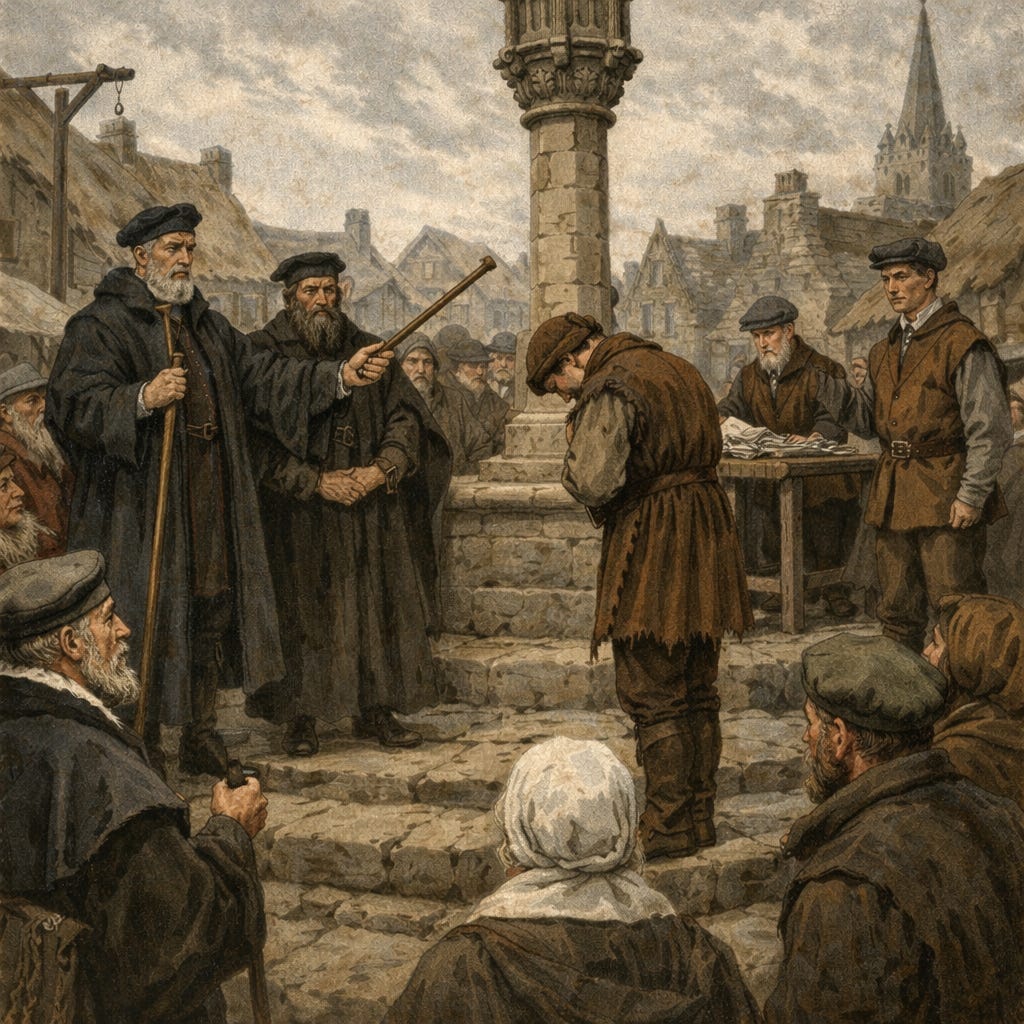
Why wield such a heavy penalty? Because the burgh ran on cooperation. Without a police force in the modern sense, Arbroath relied on rituals and reputations: apologies at the market cross or chapel, peace bonds to keep tempers in check, and graduated fines to correct behavior. Tyne his freedom sat at the far end of that spectrum—reserved for acts that undermined the community’s safety or the council’s authority.
The entries show the council preferred repair over ruin. First, they tried to mend the social fabric—public confession, forgiveness, and a warning that “next time” would be worse. But the same pages make clear that freedom was conditional on trust. Break that trust in a way that risked plague, riot, or chronic contempt for law, and the town would cut the cord.
In the end, “tyne his freedom” reminds us that for early modern towns, citizenship was a contract. Freedom wasn’t just a birthright; it was a living exchange: trade and voice in return for obedience and care for the common weal. Lose one side, and you lost the other. The phrase may be short, but it closes doors—shop doors, council doors, and, most painfully, the door of belonging.
Adapted From: Miller, D. (1860). Arbroath and its abbey: Or, the early history of the town and abbey of Aberbrothock, including notices of ecclesiastical and other antiquities in the surrounding district. T. G. Stevenson.